Is SEO Dead Now That Homeowners Ask AI for Home Services?

SEO is not dead for a plumbing, roofing, HVAC or electrical business, but some homeowners now ask an AI tool before they hire. In a vendor survey of 2,000 US homeowners who had hired a trades professional, 22% now use AI tools such as ChatGPT to research or find recommendations.[1] We put 8 US homeowner questions to four AI engines on 13 November 2026. Of the 32 answers, 20 named or recommended a licensing board, trade body or register, 12 listed a contractor's own page among their sources, and 3 named a company. The first two steps are to put your own job questions to the engines and to check that your state licence record, business profile, directory listings and website all agree.
Is SEO dead for a plumber, roofer, HVAC contractor or electrician?
No. A homeowner who asks an AI tool gets a written reply built from the pages, licence records and directories the engine can read. The groundwork behind a good local ranking (a complete Google Business Profile, reviews, accurate listings, pages that load and say what the business does) still supplies those pages.
The vendor survey cited in the opening paragraph was run by Scorpion, a provider of digital marketing for local businesses. Published in February 2026, it covered 2,000 US homeowners aged 25 and older who had hired a trades professional within the previous 18 months, and was fielded in late 2025.[1] A second vendor survey, from a financing company that markets to contractors, asked 1,000 US homeowners about AI. Its report page says 52% have used AI to double-check a contractor's estimate, and does not state the base for that figure.[4]
The general case for any business, with a side-by-side comparison of SEO and answer engine optimisation, sits in our guide to whether SEO is dead. The guide to zero-click search covers what fewer clicks do to leads.
How does a homeowner's question change from one kind of job to the next?
We grouped the questions by what has happened to the house, and every trade meets all three situations. A business's pages have to answer a different question in each.
Something has failed now. Water through the kitchen ceiling, no heat or hot water, half the house without power, shingles torn off in a storm. The question turns on who can attend today and whether a stranger can be trusted under pressure.
A replacement is planned. A furnace or AC unit, a water heater, a breaker panel, a roof, a heat pump, an EV charger. The homeowner has time to compare quotes and wants to know what the job should cost and who is licensed to do it.
A name is already in hand. A neighbour's recommendation, a truck seen on the street, a stranger at the door offering to fix the roof. The question is whether this particular business is real and licensed in the state where the homeowner lives, and the answer is a fact someone can check.

We built the 8 test questions in the next section around these situations, plus questions about how to find a contractor.
What did four AI engines say to US homeowner questions about hiring a contractor?
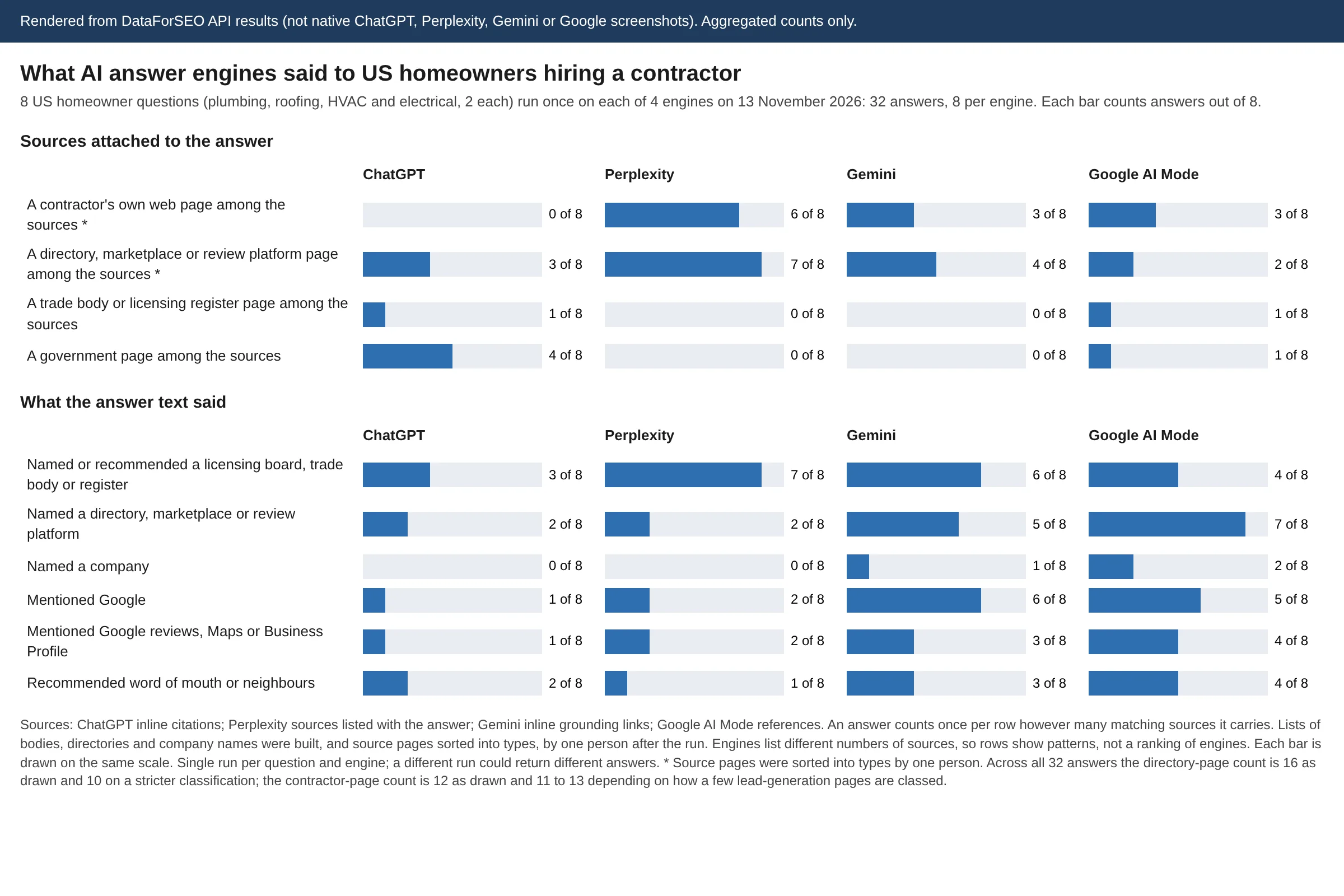
They named a licensing board, trade body or register in 20 of 32 answers, a directory, marketplace or review platform in 16 and a company in 3.
How the test ran
On 13 November 2026 we put 8 questions a US homeowner might type about hiring a plumber, roofer, HVAC contractor or electrician (two per trade) to ChatGPT (gpt-5.4-mini), Perplexity (sonar), Gemini (gemini-3.6-flash) and Google AI Mode, once each, through the DataForSEO API. That gave 32 answers, 8 per engine. Google AI Mode is the conversational mode inside Google Search; we did not test the AI Overviews box.
These are API results, not the consumer apps, with no signed-in user; ChatGPT, Perplexity and Gemini ran on lower-cost model tiers. Every figure from the run is a count of answers (out of 32, or out of 8 per engine); none is a percentage. One person built the lists of bodies, directories and company names for each country and sorted the source pages into types after reading the answers. A different run could return different answers.
The 8 questions, grouped by trade:
- Plumbing. A burst pipe sending water through the kitchen ceiling, and how to find a licensed emergency plumber tonight; whether Google is still the best way to find a good local plumber.
- Roofing. What a full roof replacement costs in 2026 and how to find a licensed and insured roofing contractor; the best way to find a trustworthy roofing contractor.
- HVAC. A furnace that has stopped working with no heat, and how to get a technician out fast; what a new gas furnace costs and who to get quotes from.
- Electrical. Half the power out and a breaker that keeps tripping, and whether that needs an emergency electrician; how to check that an electrician is licensed and insured.
Licensing boards and registers
Of the 20 answers that named or recommended a licensing board, trade body or register, 11 named a specific body or state department; the other 9 pointed only to a state licensing board in general terms. At least 19 of the 32 told the reader to verify, or to ask about, a contractor's licence.
The furnace-failure question was the exception. None of its four answers named a licensing board or trade body, and three of the four did not mention a licence at all.
Companies named
Three of the 32 answers named a company. Two named national chains (three chains in all), and one listed a pair of big-box retailers under options to approach with caution. Two of the three answered questions that did not ask who to hire.
Directories and review platforms
Sixteen of the 32 answers named a directory, marketplace or review platform in the text (11 if a consumer-body accreditation listing is not counted as one).
What the answers said about Google
Google came up in 14 of the 32 answers. Google reviews, Google Maps or a Google Business Profile came up in 10: 7 named Google Maps and 5 named Google reviews or a Business Profile (2 named both). Three of the four answers to the question about Google also mentioned Google's Local Services Ads or its "Google Guaranteed" badge.
Asked whether Google is still the best way to find a good local plumber, all four engines said Google is a starting point, and none said it was enough on its own. One answer from each engine, from one run:
- ChatGPT: ‘For most people in the US, Google is still the best starting point for finding a local plumber’, followed in the same sentence by ‘but not just plain Google search’.
- Perplexity: ‘Google is still the best starting point, but it is not the best screening method by itself.’
- Gemini: ‘While Google Search remains the most common starting point for finding a local plumber in the U.S., it is no longer considered the "best" stand-alone tool.’
- Google AI Mode: ‘Google remains a dominant starting point for finding a local plumber’, with the sentence going on to describe results crowded with lead-generation sites and large franchise chains that pay for top ad placement.
Our guide to the questions homeowners ask AI before hiring a plumber takes them one at a time and says what each tests on a business.
What appears among an AI answer's sources besides a contractor's own website?
Directory and review-platform pages, contractor pages, government pages, forum threads and trade-body pages. A listed page is not necessarily one the answer relied on.
Contractor pages. A contractor's own web page was among the sources in 12 of the 32 answers (11 to 13, depending on how a few lead-generation pages are classed). In one of the 12, the answer also named that contractor.
Directories and review platforms. A directory, marketplace or review-platform page was among the sources in 16 of the 32 answers; on a stricter classification the count is 10.
Trade bodies, licensing lookups and government. Two of the 32 listed a trade-body page, and two more listed a state contractor-licensing lookup page. Five listed a government page, four of them consumer-protection advice pages and one a state licensing lookup.
Forums. Five of the 32 listed a Reddit thread.
Our reading, which is interpretation: contractors' own pages appeared among the sources in 12 of 32 answers while a company was named in 3. The study does not show whether either produces leads.
How did the matched UK run compare?
On 32 answers per side, the two runs were similar for contractor pages (12 and 12) and directory pages (16 and 16 on our classification). Licensing and register mentions differed (20 US, 31 UK), though 9 of the 20 US answers named no specific body. Register pages (2 and 13), Google Maps mentions (7 and 3) and warnings about the top Google result (1 and 6) also differed.
For comparison we use the 32 answers (8 per engine) that the same four engines gave on 12 November 2026 to the eight UK questions closest in meaning, taken from a larger run of 64 UK answers to 16 UK questions. The US and UK questions are matched, not identical: two US questions name one trade where the UK question covers several or any, and three of the US questions say "licensed" where only one of the matched UK questions says "registered".
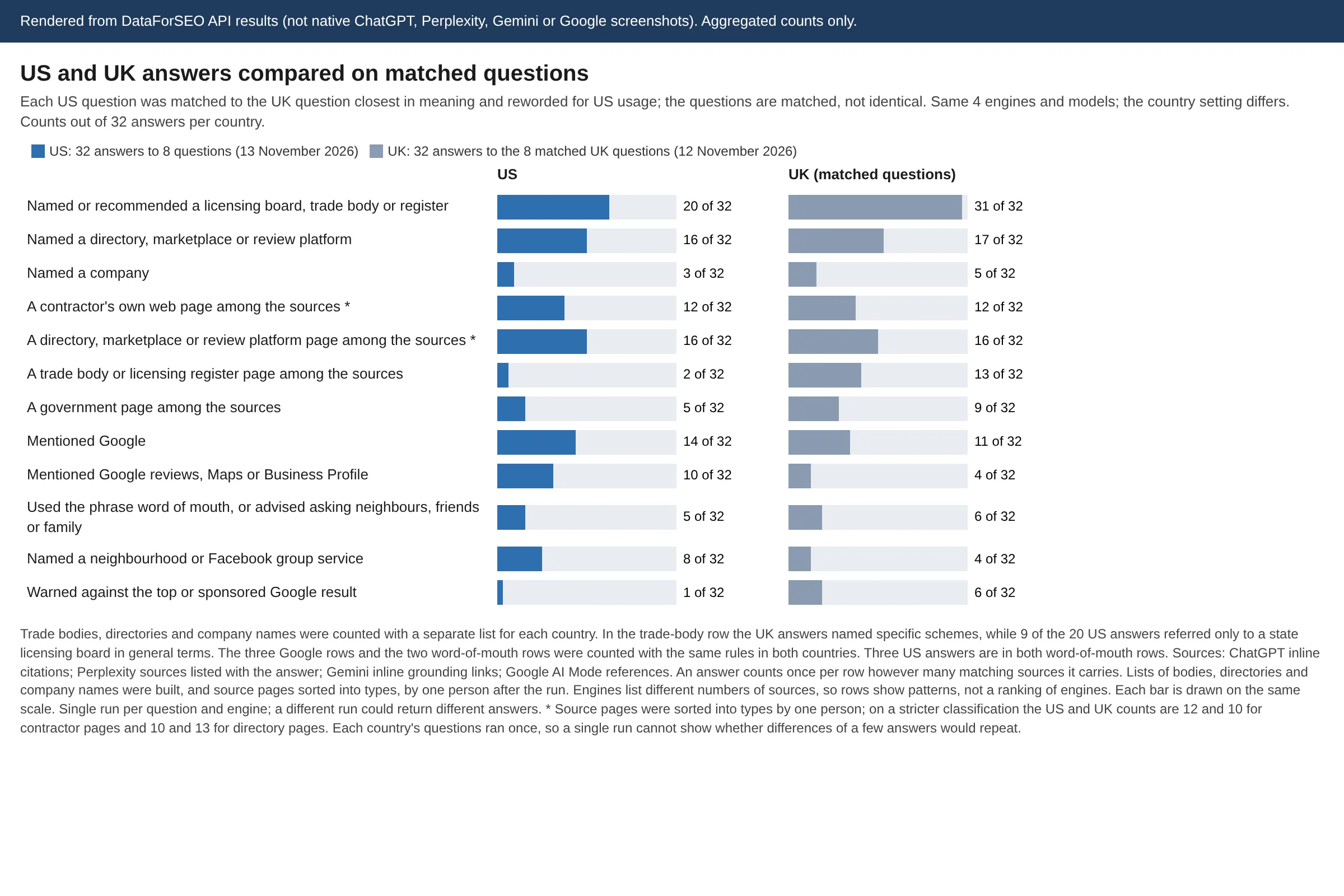
Licensing bodies and registers. In the US set, 20 of 32 answers named or recommended a licensing board, trade body or register, against 31 of 32 in the UK set. Every one of the 31 UK answers named a specific scheme, such as Gas Safe, NICEIC or TrustMark; 9 of the 20 US answers referred only to a state licensing board in general terms. The US and UK lists of bodies were built separately, so the two counts are not like-for-like. A trade-body or register page was among the sources in 2 of 32 US answers and 13 of 32 UK answers (4 against 13 if two state licensing lookup pages are counted for the US). A government page was among the sources in 5 US and 9 UK answers.
Directories, contractor pages and review platforms. A contractor's own page was among the sources in 12 of 32 US answers and 12 of 32 UK answers (12 and 10 on a stricter classification). A directory, marketplace or review-platform page was among the sources in 16 and 16 on our classification, and in 10 against 13 on a stricter one, so we describe the two countries as similar. In the text, 16 of 32 US answers and 17 of 32 UK answers named a directory, marketplace or review platform. A forum page was among the sources in 5 US and 2 UK answers, all five US ones a Reddit thread.
Companies named. A company was named in 3 of 32 US answers and 5 of 32 UK answers.
Google and word of mouth. Google came up in 14 of 32 US answers and 11 of 32 UK answers. Google reviews, Google Maps or a Business Profile came up in 10 US answers and 4 UK answers, and most of that difference is mentions of Google Maps (7 US answers, 3 UK). A warning against the top or sponsored Google result appeared in 1 of 32 US answers and 6 of 32 UK answers. Three US answers to the Google question mentioned Google Local Services Ads; none of the 32 UK answers did. The phrase "word of mouth", or advice to ask neighbours, friends or family, appeared in 5 US answers and 6 UK answers. A neighbourhood or Facebook group service was named in 8 US answers and 4 UK answers.
The nearest UK question asked about tradespeople in general and drew a similar starting-point message from all four engines, for example ChatGPT: ‘Google is useful, but it’s not the best place to stop.’ The guide for UK tradespeople covers UK accreditations and trade directories.
These are differences between counts from one run of 32 on each side. They do not show that the engines behave differently in the two countries.
Where does classic local SEO still show up?
It shows up in the business profile, reviews and the state licence record. Site speed and crawlability were not tested in this run.
Reviews set a threshold: in the Scorpion survey, 87% of US homeowners said they would not hire a business rated below 4 stars.[1]
The state licence record is one more entry to keep accurate. Licence and insurance requirements vary by state: the federal Energy Star programme's tips for hiring a heating and cooling contractor open with ‘Find out about license and insurance requirements for contractors in your state’.[5] The guide to local AEO groundwork covers the full set of local signals.
Our run did not measure rankings. Our comparison of Google rankings and ChatGPT answers covers whether a top Google ranking carries into an AI answer.
Where does a trade need its own treatment?
The run asked two questions per trade, so this article gives no per-trade counts.
Roofing. Storm damage is a separate situation, and the guide to storm-damage pages for roofers explains why it needs its own pages.
HVAC. The guide to AEO for heating and cooling firms covers repair-or-replace pages, seasonal pages and technician credentials.
Electrical. For an electrician:
- Licence record. Electrician licensing rules differ by state. In Texas, for example, anyone who ‘performs, or offers to perform, non-exempt electrical work in the state of Texas must be licensed and perform that work through a licensed electrical contractor’.[6] An electrician's page should give the licence type as well as the number, as the state board shows them.
- No planned job in the run. A panel replacement or an EV charger install was not among the questions, so this article has no counts for one.
What does it cost a home services business to sit still?
It costs the jobs that go to another business, and what one job is worth depends on the trade. The job values, lost-job counts and revenue totals below are illustrative, set beside the Census medians.
The 2023 American Housing Survey, published by the US Census Bureau and the Department of Housing and Urban Development, reports median homeowner spend for selected projects over 2021 to 2023, rounded to the nearest $100. The medians were roofing $10,000, HVAC $5,500, electrical wiring and fuse boxes $1,000, and plumbing fixtures $500.[2] These are US medians per project type, spent by homeowners, and may include do-it-yourself work. They are neither a contractor's price list nor its profit, and the plumbing figure covers fixtures only. Harvard's Joint Center for Housing Studies reported in its 2025 key facts that US spending on professionally installed improvements grew between 2021 and 2023 and ‘comprised an unprecedented 84.1 percent of expenditures on owner-occupied homes’.[3]
| Trade | Median project spend, 2021 to 2023 (US data) | Example job value (illustrative) | Example jobs lost a month (illustrative) | Example revenue lost a year (illustrative) |
|---|---|---|---|---|
| Roofing | $10,000 (roofing) | $12,000 | 1 | $144,000 |
| HVAC | $5,500 (HVAC) | $7,000 | 1 | $84,000 |
| Electrical | $1,000 (wiring and fuse boxes) | $1,500 | 2 | $36,000 |
| Plumbing | $500 (plumbing fixtures only) | $400 | 2 | $9,600 |
The last column is the example job value times the example jobs lost a month, times 12: a roofing business that loses one $12,000 job a month has lost $144,000 of revenue in a year. Revenue is not profit, and the example ignores costs.
A single job understates the loss, because a customer can come back and recommend the business. Lifetime value is the value of the first job, each repeat job and each job the customer refers. With example inputs, not industry averages: an electrician replaces a breaker panel for $1,500, returns for two service calls at $200 each, and is recommended to a neighbour who has a panel replaced for $1,500. That customer is worth $1,500 + (2 × $200) + $1,500 = $3,400, more than twice the first invoice. Put your own job history into the formula before you decide what a lost lead costs.
In what order should a home services business act?
Find out what the engines currently say about your jobs, make the licence record, profile and listings agree, then write the pages.
- Ask the questions yourself. Take the question groups above, rewrite them for your trade and state, and put each to the engines your customers might use. Record what each says, which companies it names and which pages it lists. The guide to checking what changed after an edit shows one way to repeat that test and read the result.
- Make the details agree. The state licence record, the Google Business Profile, each directory listing and the website should carry the same business name, address, phone number and licence number. Fix any disagreement before writing anything new.
- Write one page per job situation, answer first. For a failure-now page, open with what the business would tell a caller to do while waiting, then the service area and hours. For a cost page, open with your own price range and what moves it. For a trust page, open with the licence number, the issuing state board and the insurance statement (and a bond where your state requires one), as text. Put the answer in the first two sentences. Keep structured data (the local business, the service and any FAQ) identical to the visible text.
- Ask for reviews that name the job. Request them after the job, in the customer's words, and answer the low ones factually on the platform where they sit.
- Report leads by source. Ask each new customer how they found the business and record whether an AI answer was part of it.

Where besides its own website should a home services business's details appear?
A business's details belong on the directories, licence records and forums that came up in the answers.
- Directories and marketplaces. Claim and complete the listings that appear for your trade.
- State licence records. Keep the entry complete and current.
- Manufacturer installer programmes. If a manufacturer you install for runs an approved-installer list, check that your business is on it.
- Forums. Forum threads were listed in fewer answers than directory pages, so a forum post comes after the listings.
Have QBiz test your customers' questions in ChatGPT and Perplexity →
Frequently asked questions
Should an electrician still pay for a local SEO retainer?
Pay for what keeps the business checkable and listed, and drop a report that stops at rankings. A retainer earns its fee when it keeps the state licence record, business profile, directory listings and job pages consistent, and when it reports leads by source.
Is a paid directory listing worth it now that directories appear in AI answers?
In our US run, 16 of 32 answers named a directory, marketplace or review platform, and 16 listed a directory page among their sources (10 on a stricter classification). One of the 32 US answers, from Gemini, said that businesses pay to receive homeowners' contact details on many match platforms; the study made no other count of whether directories charge contractors. Judge a paid listing by the leads it records.
Do AI answers point homeowners to word of mouth?
At least 10 of the 32 US answers recommended word of mouth, neighbours or local groups: 5 in those words and 8 by naming a neighbourhood or Facebook group service (3 did both). The figure is a floor, because a keyword rule produced it. A business cannot edit that advice, but it can make a recommendation easy to act on: when a neighbour gives a name and the homeowner searches it, the licence record, profile and website should agree.
What should I ask an agency that tells me SEO is dead?
Ask what it will measure and how it will show the result. Useful requests are the answers each engine gives to your own job questions before any change, the pages it proposes to change and why, and leads by source afterwards.
Does the UK comparison run apply to a US business?
Not directly. The US run is the primary evidence here. The UK comparison records what engines said to UK questions. Neither run records what homeowners do, so measure your own lead sources to find your own numbers.
I do plumbing and HVAC, or HVAC and electrical. Should I write one set of pages?
Write one page per job situation per trade. A single services page that covers furnaces, bathrooms and breaker panels cannot open with the answer to any one of those questions. The same licence and profile details can appear on every page.
Sources
- [1] Scorpion, "Scorpion's New Industry Report Reveals a Disconnect Between Homeowners and Local Service Businesses" (PR Newswire, 19 February 2026): https://www.prnewswire.com/news-releases/scorpions-new-industry-report-reveals-a-disconnect-between-homeowners-and-local-service-businesses-302692223.html
- [2] US Census Bureau and US Department of Housing and Urban Development, "2023 Home Improvements Infographic" (2023 American Housing Survey): https://www.census.gov/content/dam/Census/library/visualizations/2024/demo/2023%20Home%20Improvements%20Infographic.pdf
- [3] Harvard Joint Center for Housing Studies, "Improving America's Housing 2025: Key Facts": https://www.jchs.harvard.edu/sites/default/files/interactive-item/files/Harvard_JCHS_Improving_Americas_Housing_2025_Key_Facts.pdf
- [4] Acorn Finance, "2026 State of AI & Homeownership Report": https://www.acornfinance.com/contractor-resources/state-of-ai-and-homeownership-report-2026/
- [5] ENERGY STAR, "10 Tips for Hiring a Heating and Cooling Contractor": https://www.energystar.gov/saveathome/heating-cooling/10-tips-hiring
- [6] Texas Department of Licensing and Regulation, "Electricians": https://www.tdlr.texas.gov/electricians/
Leave a comment
Thoughts on this post? Leave a comment below. Comments are moderated before they appear, so yours will not show on the page straight away.
Your email is used only to contact you about your comment if needed; it is never published.
Comments
No comments yet. Be the first to leave one above.