Specialist Treatment Pages or One General Page: What AI Search Cites for UK Dentists in 2026
For AI search, a dedicated page per treatment almost always out-performs a single general page, because assistants reach for the most specific page that directly answers the query. The general page still has an important job, anchoring who you are, just not the job of winning treatment queries. Build one deep page per treatment you offer, keep the general page as the trunk, and word each page around the title the treating clinician actually holds.
Implants, full-arch work and clear aligners are the cases that carry a practice. The patient who arrives for one of them often stays for routine and family care, and for their family's. So when a patient asks an AI assistant "who does dental implants near me" and it names a practice down the road instead of yours, that is not a vanity problem. That is a high-value case walking through someone else's door, and it happens silently, with no enquiry form for you to miss and no missed-call alert to chase.
Should you build a deep, dedicated page for each treatment you offer, or is one good "we're a friendly local dentist" page enough? Most practice owners never frame it as a decision at all. They have a homepage, a services list with implants as one line among twenty, and a vague sense that the website "is fine." Meanwhile the assistants patients now ask pull answers from whichever page answers the question most directly. A one-line mention is rarely that page.
The rest of this guide works through it under General Dental Council rules, for UK practices.
Specialist treatment pages or a general dentist page: which does AI actually cite?
A deep treatment page wins the specific query almost every time, with one condition attached: it has to have real substance behind it. The assistants behind ChatGPT, Google's AI answers, Perplexity and Copilot work by finding the source that most directly answers what was asked, then summarising it. When a patient asks about implants, a focused implants page is a far tighter match than a homepage where implants are a single bullet. That page covers cost, suitability, the process, the alternatives and the common worries. So the page that gets quoted is the specific one, provided it actually answers the question rather than just naming the treatment.
The reason this matters now, rather than as a someday concern, is that the AI answer has become the surface patients read first. About six in ten people (58%) saw at least one AI-generated summary in their Google searches in March 2025, and when one appears they very rarely click through to the older links beneath it [1]. Those assistants have also become a mainstream way people choose local businesses: AI tools such as ChatGPT have risen into third place as a source of local-business recommendations [2]. And patients are bringing health questions to them directly, with about a third (32%) of adults now using AI for health information or advice [3].
Put those together and the stakes are plain. A rising share of patients decide which dentist to consider inside an AI reply, that reply names the source it can most specifically verify, and you cannot buy your way into it. The page you build is the only lever you have, which is exactly why the build-per-treatment-or-not question is worth getting right.
Why does AI search reward the specific page over the general one?
"Specialist versus general" here means page specificity: a dedicated page per treatment (implants, clear aligners, root canal treatment, whitening, children's dentistry) against one broad page describing the whole practice. Practice type, a single-discipline orthodontist or endodontist against a general family dentist, is a separate question covered further down. A practice does not need to become a specialist practice to win treatment queries; it needs to give each treatment it offers a page worth citing.
These systems optimise for relevance to the exact question, and a dedicated page is simply more relevant to a specific query than a catch-all page is. An assistant answering "do I need a root canal or an extraction" wants a source that addresses that decision directly. A page devoted to root canal treatment that explains when it is needed, what the alternative is and what to expect can be quoted almost verbatim. A homepage that lists "root canals" alongside nineteen other services gives the assistant nothing clean to lift.
This is not a quirk of AI; it sits on top of how local results have always been weighed. Google describes its local results as resting primarily on relevance, distance and popularity, working together to find the best match for a search [4]. A treatment-specific page maximises the relevance half of that for a treatment query in a way a general page structurally cannot. The general page is trying to be relevant to everything at once, so it is sharply relevant to nothing in particular.
The mechanics underneath this are worth understanding properly, and they tie into two neighbouring pieces in this series. How your facts are marked up so a machine can read them without guessing is the schema question (see the dental schema markup guide, article 11). Whether the assistant trusts the page enough to quote it is the experience, expertise, authority and trust question (see the E-E-A-T guide for dentists, article 12). A specific page gives both of those something concrete to work with: clear, marked-up facts about one treatment, written by an identifiable clinician. A general page spreads both thin.
What counts as a "specialist page," and which treatments deserve one?
A specialist page here means a treatment-specific page: one page, one procedure, written to answer everything a patient weighing that procedure would ask. It is not about holding a registered specialist title (more on that in the UK section); it is about depth on a single treatment. The practical question is which treatments earn one, and the plain answer is the ones you genuinely provide and that patients genuinely search for.
A useful way to map your candidates is by treatment family, then pick the ones that carry real patient demand and real value for your practice:
- Preventive: check-ups, hygiene, sealants, the routine care that anchors lifetime patient value.
- Restorative: fillings, crowns, bridges, and the work that rebuilds a damaged tooth.
- Implants and tooth replacement: single implants, multiple implants, full-arch solutions, dentures.
- Cosmetic: whitening, veneers, bonding, smile makeovers.
- Orthodontic: clear aligners and fixed braces for adults and teenagers.
- Endodontic: root canal treatment and retreatment.
- Surgical and urgent: extractions, wisdom teeth, emergency appointments.
You do not need a page for every line on that list. You need a strong page for each treatment you actually offer and want more of, starting with the high-value, high-intent ones. A practice that does implants and aligners well, and earns most of its growth from them, should have an excellent implants page and an excellent aligners page long before it worries about a page on fluoride varnish. Build to your strengths and your patients' questions, not to a checklist.
Specific intent
Match the page to the treatment question a patient is asking.
Useful treatment detail
Explain the detail a general page cannot carry for every treatment.
Accurate scope
Keep the page within the practice’s real services and UK requirements.
What does a strong treatment page actually contain?
It answers the patient's question in the first breath, then works through the things a patient genuinely wants to know in a predictable order a machine can follow. A reliable anatomy for a treatment page that earns citations runs through nine parts:
- A plain-language summary up top. Two or three sentences answering the core question (what it is, roughly what it costs, who it suits) before anything else. This is the part an assistant lifts.
- What the treatment actually is. A clear explanation in patient terms, not clinical shorthand.
- When you need it. The symptoms or situations that lead to it, so a patient self-identifies.
- What to expect. The steps, the timeline, the recovery, the frank detail about comfort.
- Cost and how payment works. Realistic, clearly-framed information, including NHS versus private where it applies, without overpromising.
- The clinician's perspective. A named dentist's view, which is where genuine expertise and first-hand experience show through (article 12 covers why this carries so much weight).
- The alternatives. What else could address the same problem, and the real trade-offs, which builds trust rather than undermining it.
- Questions patients actually ask. A short, real Q&A in the patient's own words.
- A clear next step. How to book or ask, without pressure.
Mark the whole thing up so the facts are machine-readable, pairing Dentist details with MedicalProcedure, and FAQPage information for the questions. The The dental schema markup guide, article 11, walks through the markup itself. Note that FAQ markup no longer earns a special Google result: that feature was retired in May 2026, so add it for clarity and machine extraction rather than for a search badge.
A page built this way is answer-first, specific and verifiable, which is the combination assistants reach for, and the same principles apply to every page you write. A page missing the first item, the summary, fails before it starts, because the assistant has to dig for the answer instead of being handed it.
The blunt caveat: a deep treatment page wins, a thin one loses
Specificity only wins when there is substance behind it. A treatment page that is three thin paragraphs and a booking button is not a more specific answer; it is a worse page that happens to have a narrow title. Twenty near-identical stubs, each lightly reworded from the last, do not give you twenty chances to be cited. They dilute your authority, look like filler to both readers and machines, and risk the old doorway-page problem of many shallow pages built to catch queries rather than to help anyone.
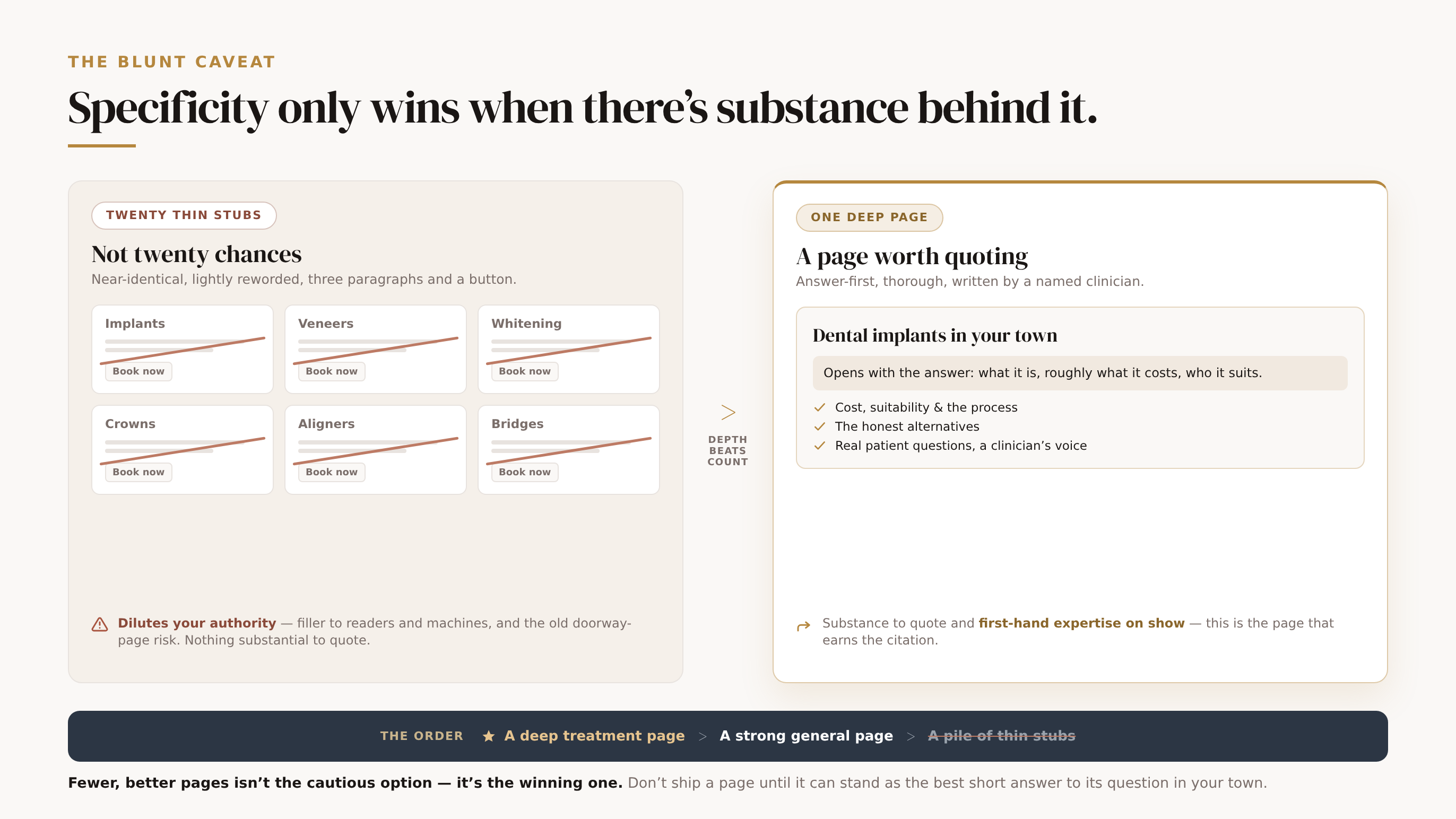
Google's own guidance is the clearest authority for this. It rewards content that provides substantial value compared with other pages and that demonstrates first-hand expertise and a real depth of knowledge [5]. A thin stub fails that bar by definition. It has nothing substantial to quote, no expertise on show, no depth for an assistant to draw on. So it sits there, narrow and empty, earning nothing.
So the order runs: a deep treatment page, then a strong general page, then a pile of thin stubs a long way behind. Do not ship a page until it can stand on its own as the best short answer to its question in your town. If you cannot make the implants page genuinely good this month, keep implants as a strong section elsewhere until you can, rather than putting up a hollow page that drags your credibility down with it.
Treatment page versus general page: the plain side-by-side
The quickest way to see why these are different tools for different jobs is to put them next to each other. This table is the spine of the whole decision.
Side by side
Treatment page versus general page
| Treatment (specialist) page | General dentist page | |
|---|---|---|
| What it targets | One treatment, for example implants in your town | The practice as a whole, your identity and brand |
| The query it wins | Specific, high-intent treatment questions | "Who is this practice / a dentist near me" questions |
| The job it does for AI | Be the most relevant, citable answer to a treatment question | Anchor who you are and tie the treatment pages together |
| Depth required | High: the nine-part, answer-first, marked-up anatomy | Moderate: clear identity, locations, the team, links |
| It wins citations when | It is genuinely deep and answers the question up top | Not the right tool for treatment queries; it is the anchor |
| The failure mode | A thin or duplicate stub, so authority dilutes and nothing is quotable | Trying to win every treatment query from one crowded page |
| The plain verdict | Build one per treatment you offer, deep not thin | Keep it, but do not ask it to win treatment queries |
The argument is in the pattern. One column is the page that earns the specific recommendation; the other is the page that establishes who is being recommended. They are not in competition. Asking the general page to win treatment queries is like asking your reception sign to perform the surgery. It is the wrong tool, doing badly a job another page does well.
So what is the general page still for? Do not delete it
It is your identity anchor, and that is a real and necessary job. The general page (your homepage and a broad "about the practice" page) answers the questions a treatment page cannot:
- Who is this practice?
- Where are you?
- What is the feel of the place?
- Who are the dentists?
- What do you stand for?
When an assistant is working out whether your practice is a real, trustworthy entity it can name, this is the page that establishes that. It is the trunk; the treatment pages are the branches.
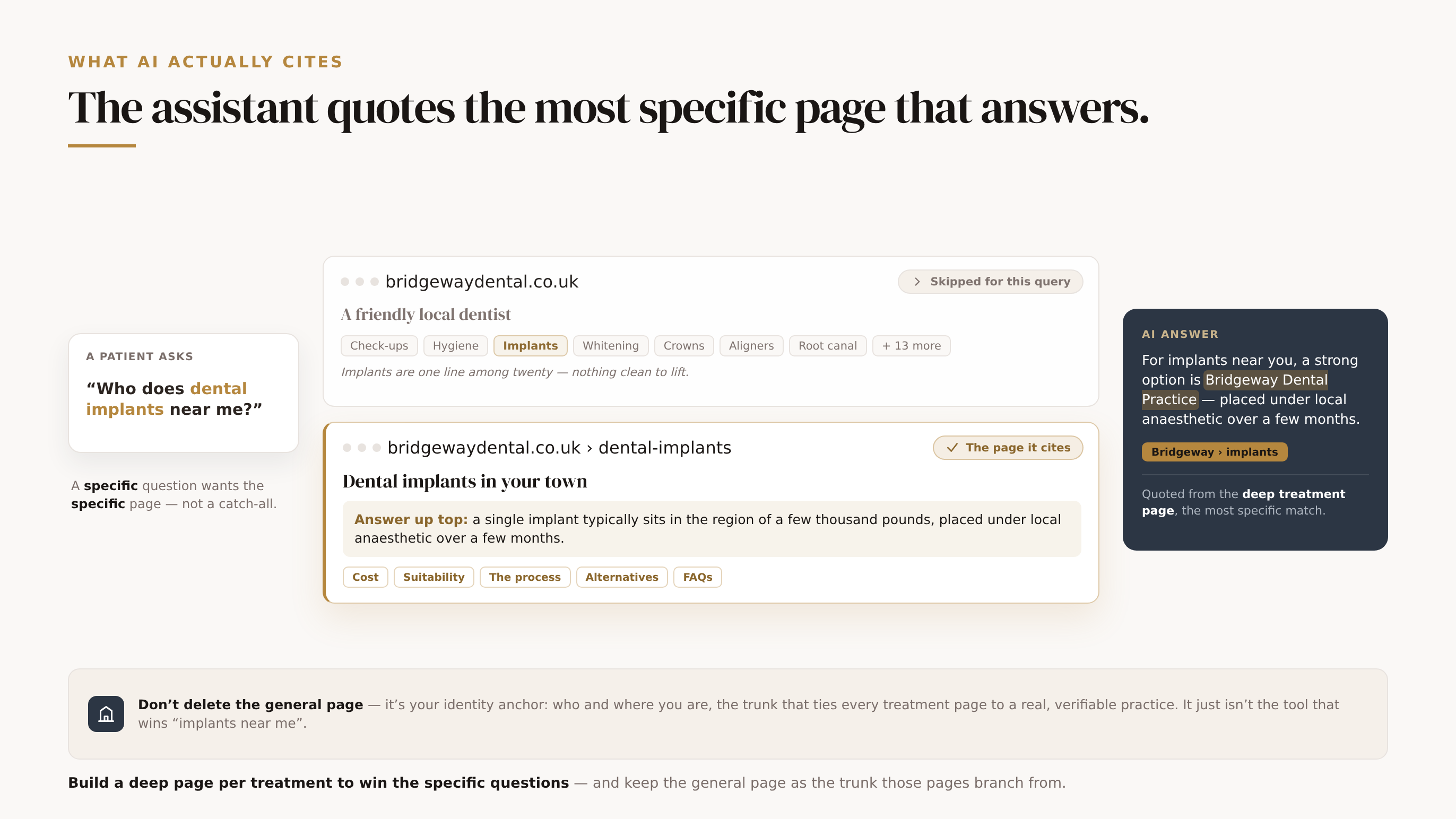
That entity role feeds everything else. The clearer and more consistent your general page is about who you are and where, the more confidently an assistant can attach your specific treatment pages to a real, verifiable practice. A patient asking "is there a good family dentist in this area" is asking exactly the kind of question a strong general page should win. The mistake is not having a general page; the mistake is expecting it to also win "implants near me" and "emergency dentist tonight" from the same crowded space.
So keep it, and keep it strong, but give it the right job. Let it say who you are with clarity and personality, link cleanly out to your treatment pages, and stop trying to make it carry queries it was never shaped to answer.
How many treatment pages should a dentist build, and in what order?
Build them in order of value and demand, one strong page at a time, and never let the count outrun the quality. The sequence that works puts your earnings and your patients' real questions first:
- Start with your highest-value, highest-intent treatments. For most practices that means implants, clear aligners, cosmetic work and emergency care: the treatments worth most and searched with the clearest intent to book.
- Make each one genuinely deep before moving on. Build it on the nine-part anatomy, with a named clinician's voice and proper markup. One excellent page beats three half-finished ones.
- Expand only as fast as you can keep each page strong. Add the next treatment when you can give it the same depth, not on a schedule that forces you to cut corners.
- Never ship a stub to "cover" a treatment. A treatment with no strong page yet is better served as a solid section on a related page until you can do it properly.
One genuinely excellent treatment page a month gives you twelve citable pages inside a year, each one still earning in the year after that.
Are specialist practices (orthodontists, endodontists) at an advantage in AI?
Yes, but the advantage is one a general practice can copy, which is the useful part of the answer. A single-discipline specialist practice is, in effect, one large treatment page given physical form. Everything on its site points at one area, so it naturally has the depth, focus and consistency that AI rewards for that area's queries. An orthodontic practice that does nothing but aligners and braces is hard to beat on "best orthodontist near me," because its whole site is the most specific possible answer.
A general practice does not need to narrow itself to compete; it needs to recreate that focus page by page. A strong, deep implants page gives a general practice the same concentrated relevance on implant queries that a specialist practice gets across its whole site. The lesson generalises cleanly: depth and specificity win, whether they come from being a specialist practice or from building specialist-grade pages within a general one. You are matching the specialist's focus on the questions that matter to you, one excellent page at a time.
One important UK caveat sits underneath this, which the next section covers: who may actually call themselves a "specialist" is regulated, and a treatment page is not a place to imply a status you do not hold.
What does the UK picture look like (GDC titles, scope of practice, NHS and private)?
One UK rule changes how a treatment page is worded. "Specialist" is a protected term: the General Dental Council maintains specialist lists, and only dentists on the relevant list may use a specialist title such as "specialist orthodontist." A general dentist who provides orthodontic treatment can still build a deep, citable page about it. The page has to describe the treatment on its own terms and attribute it to the clinician by the title they actually hold, rather than implying a registered specialist status.
The GDC is explicit that the list governs the title, not the treatment: "Dentists do not have to join a specialist list to practise any particular specialty, but they can only use the title 'specialist' if they are on that list" [6]. That is the sentence that settles most practice owners' hesitation about publishing a treatment page at all. Eleven specialties are recognised under the GDC (Specialist List) Regulations 2024 [6], so for every treatment outside those eleven the question of a specialist title does not arise, and the page is simply a description of the treatment you provide.
That has a direct AEO consequence. The wording that keeps the page accurate is also the wording an assistant can verify, because a page stating exactly who does what is easier to quote than one hedged around a title it cannot support.
The NHS-versus-private distinction is the other UK detail worth building into each treatment page. Patients want to know which route a treatment falls under and what that means for them, and stating it on the relevant page gives the assistant a cleaner, more specific answer to quote. British terminology matters too: write "clear aligners" and "root canal treatment" the way UK patients and clinicians say them, because that is how the questions are asked.
How can you check which of your pages AI actually cites?
You can audit this yourself in an afternoon, for nothing, before changing a single page, and the guide to how AI ranks dentists covers what to do with what you find. The point is to find out whether the assistants name you, and from which page, so you fix the right thing rather than guessing.
Start by asking the assistants the questions your patients ask. Type your real treatment queries ("dental implants in [your town]," "Invisalign near me," "emergency dentist [your town]") into ChatGPT, Google's AI answers and Perplexity, which each source answers differently, and note whether your practice is named and, if you can tell, which page it drew on.
Then open each of your own treatment pages and check two things: does it answer the core question within roughly the first fifty words, and are the facts marked up so a machine can read them cleanly (article 11 shows what good looks like). Finally, sanity-check your general page: does it state clearly who you are and where, and link out to those treatment pages? That audit tells you quickly whether the treatment queries are being won by a competitor who built the deep, specific page you did not.
How does QBiz help, on the site and across the wider web?
QBiz builds the treatment pages and handles the distribution behind them. On the site, we get each treatment you offer into a state an assistant can verify and quote:
- A deep, answer-first page per treatment, built on the nine-part anatomy above.
- Machine-readable markup, so a model reads your facts without guessing.
- A general page that anchors who you are and links out to the treatment pages.
- UK framing that names treatments and titles accurately under GDC rules.
Off the site, we get those signals out across the wider web where the assistants look, which is where coverage on other sites starts to count. A page nothing else references is a page an assistant struggles to trust, however well it is written.
The pairing is the point. An AI answer is assembled from agreement across many sources, not from your website alone, so building excellent pages and then making sure the wider web reflects them is what turns a practice the assistant cannot place into the one it names. Optimising your own site is necessary but not enough by itself; the distribution is what gives the on-site substance somewhere to land. It is also the half that most practices forget, which is why a beautifully written page can still go uncited.
If you want to know where you stand today, a QBiz AI Visibility audit checks whether the assistants already name your practice for your town's treatment queries, and whether they are pulling from a deep treatment page or skipping past a thin one.
It is the sensible place to start, because it shows you which pages are earning citations and which treatments are quietly handing patients to a competitor with a better page.
Frequently asked questions
Do specialist pages or a general dentist page rank better in AI search?
Deep treatment-specific pages win the specific treatment queries, while the general page anchors your identity. When a patient asks an assistant about a particular treatment, it reaches for the most specific page that directly answers the question, and a dedicated treatment page is a far closer match than a homepage where that treatment is one line. The general page still matters for "who is this practice" questions; it is just not the page that wins "implants near me."
Should I build a separate page for each dental treatment?
Yes, for the treatments you genuinely offer and that patients actually search for, and only if you can make each page genuinely deep. A strong, answer-first page per treatment is what earns AI citations. A thin stub does not, and a pile of near-identical stubs can dilute your authority and harm your credibility. Build to your strengths, one excellent page at a time, rather than rushing out a page for everything.
Is one good general page ever enough for AI search?
For brand and identity questions, a strong general page can be enough; for treatment questions, it is not. The general page answers "who is this practice and where," which is a real and useful job. It cannot, however, be the most specific answer to "do I need a root canal" or "best implant dentist near me," because those queries are won by pages built around exactly those questions. Where the general page does earn its citations is identity: being unmistakable about who you are, where you are and who works there.
How many treatment pages should a dental website have?
As many strong ones as you can sustain, and no thin ones. Start with your highest-value, highest-intent treatments, build each on a proper answer-first structure, and add the next only when you can give it the same depth. For most practices that means starting with three or four pages rather than twenty, and treating the count as an outcome of the standard you hold, not a target to hit.
Does ChatGPT cite the homepage or the treatment page?
Usually the specific, well-structured treatment page, when one exists and answers the question clearly. Assistants favour the source that most directly addresses what was asked, so a focused treatment page that opens with a plain answer tends to be quoted over a broad homepage. If your treatments live only as bullets on a general page, you are giving the assistant nothing specific to cite (the AI citations guide, article 13, goes deeper on what gets pulled).
Two of my treatments overlap. Do they need separate pages?
Split them if patients search for them separately, and combine them if patients treat them as one decision. Clear aligners and fixed braces are asked about as alternatives to each other, so a single orthodontics page that compares both often answers the query better than two pages competing for it. Implants and dentures, by contrast, attract different patients at different stages and each carries enough distinct detail to fill a page. The test is the question, not the clinical category: if two treatments answer one patient question, they belong on one page.
Should I build separate pages for each town I serve as well as each treatment?
Only where you have a genuine presence in that town, such as a practice site, a team or a real patient base. Location-plus-treatment pages built purely to catch a query are exactly the shallow pages that damage credibility, because there is nothing true and specific to put on them. If you have one practice serving several towns, name those towns clearly on the treatment page and the general page instead, which gives an assistant the coverage detail without inventing thin pages.
Can a general dentist publish an orthodontics page under GDC rules?
Yes, provided the page does not imply a specialist title the clinician does not hold. A dentist not on the GDC specialist list can describe the orthodontic treatment they provide, explain the process and name themselves as the treating dentist. What they cannot do is use a protected title such as "specialist orthodontist" or word the page so a reader would infer that registration. Accuracy about who does what is the requirement, not silence about the treatment.
How long should a dental treatment page be?
Long enough to answer every question a patient weighing that treatment would ask, which usually means covering all nine parts of the anatomy above rather than hitting a word count. A page on a complex treatment such as implants will naturally run longer than one on whitening, because there is more a patient needs to decide. If a section exists only to add length, it will read as padding to both the patient and the assistant.
I have a thin treatment page already. Should I delete it or improve it?
Improve it in place rather than deleting it, in almost every case. The URL may already hold links and history, and rebuilding it on the nine-part structure keeps that while fixing the problem. Deleting is the right call only when the page covers a treatment you no longer offer, in which case remove it and redirect to the closest relevant page. What you should not do is leave it thin and publish more pages beside it.
Where to start
Ask ChatGPT, Google's AI and Perplexity the treatment questions your patients ask, and see whether your practice is named. If it is not, you have just watched where those cases are going, and no amount of homepage polish will win them back. What earns those mentions is a deep, well-structured page for each treatment you offer, anchored by a clear general page, marked up so a machine can read it, and referenced across the web where the assistants look. A QBiz AI Visibility audit shows which of your pages are being cited and which treatments are being handed to a better-prepared competitor.
Sources
- [1] Pew Research Center, 22 July 2025: https://www.pewresearch.org/short-reads/2025/07/22/google-users-are-less-likely-to-click-on-links-when-an-ai-summary-appears-in-the-results/ (US; independent)
- [2] BrightLocal, Local Consumer Review Survey 2026: https://www.brightlocal.com/research/local-consumer-review-survey/ (US-weighted; independent)
- [3] KFF, Tracking Poll on Health Information and Trust, 2025: https://www.kff.org/public-opinion/kff-tracking-poll-on-health-information-and-trust-use-of-ai-for-health-information-and-advice/ (US; independent)
- [4] Google Business Profile Help, "Tips to improve your local ranking on Google": https://support.google.com/business/answer/7091 (Global; vendor primary)
- [5] Google Search Central, "Creating helpful, reliable, people-first content": https://developers.google.com/search/docs/fundamentals/creating-helpful-content (Global; vendor primary)
- [6] General Dental Council, "Specialist lists": https://www.gdc-uk.org/registration/your-registration/specialist-lists (UK; regulator primary)
Leave a comment
Thoughts on this post? Leave a comment below. Comments are moderated before they appear, so yours will not show on the page straight away.
Your email is used only to contact you about your comment if needed — it is never published.
Comments
No comments yet. Be the first to leave one above.