Why Did My Website Traffic Drop This Year?
A traffic drop with unchanged or even improved rankings is one of the clearest fingerprints of AI search reshaping how clicks get distributed. Four related mechanics explain it: Google's AI Overviews answering a query directly above your result and absorbing the click that used to be yours, AI-referred visits arriving in analytics tools with no referrer and defaulting to Direct traffic instead of being counted as search-driven, unbranded and informational queries losing clicks to an answer that satisfies the question outright, and zero-click search, where the results page itself satisfies the question. None of these show up as a ranking penalty, because none of them are one. Diagnosing it takes two checks: which queries lost clicks while keeping impressions in Search Console, and whether Direct traffic grew in GA4 at the same time organic fell.
Short version
- A traffic drop with stable rankings points to AI search absorbing clicks your position still earns.
- AI Overviews can answer a query directly on the results page, so the click never reaches your site even though you still rank.
- Some AI-referred visits arrive with no referrer and get counted as Direct traffic in GA4, hiding inside a bucket that looks unrelated to search.
- A search for your business name still wants your site; a general informational question is one an AI answer can close on the spot.
- Check Search Console for queries where impressions held but clicks fell, and check GA4 for Direct traffic growing alongside an organic-search decline.
Why did my website traffic drop this year?
The confusing version of this problem is the one where nothing else has changed. You haven't lost rankings. You haven't been hit with a manual action. Search Console still shows your pages ranking roughly where they always have. And yet sessions are down, sometimes sharply, over the last several months.
That combination, stable rankings with falling traffic, is close to a signature of what AI search has done to organic click behaviour over the past year. Google still ranks your pages; searches are now answered above the results list, so the position you hold and the clicks it earns have come apart.
The four mechanics behind the drop
AI Overviews answer the question before the click happens. When Google generates an AI Overview above the organic results, it's built directly from the kind of content your page contains, summarised and presented without the visit. Your ranking position hasn't changed; the opportunity for a click above it has. How often Google answers with AI covers how frequently this happens across search categories. For this diagnostic the narrower point is enough: a page ranking well for an informational query can still lose the clicks that position used to earn.
AI-referred visits can arrive as Direct traffic. A click from inside a ChatGPT answer, or from another AI tool, can carry no referrer header. GA4 has no better bucket for a visit with no referrer than Direct, so what your reports label as flat or slightly growing Direct traffic can include AI-sourced visits being miscounted. That means an organic-search decline in your reporting can understate the real picture, or in some cases mask genuine AI-driven visits that are arriving, just filed under the wrong label. Our guide to measuring AI search ROI covers the full GA4 attribution fix, including segmenting Direct traffic properly and building a landing-page view that separates likely AI referrals.
Unbranded, informational queries are the ones an AI answer closes on its own. Someone typing your business name already wants your specific site; an AI Overview cannot satisfy that intent the way your own page can. Someone asking a general, informational question that any AI system can answer without sending them anywhere is exactly the query type AI Overviews and chat answers absorb. If your drop is concentrated in the pages that used to rank for broad, top-of-funnel questions while your branded and transactional traffic holds up, that pattern points squarely at AI answers absorbing the top-of-funnel click.
Zero-click search absorbs queries outside AI Overviews too. Even outside AI Overviews specifically, searches can end without any click at all: featured snippets, knowledge panels, and now AI-generated summaries all satisfy the query on the results page itself. Our guide to the zero-click era sets out the mechanics and scale of this shift in full. For a traffic drop the practical read is that a ranking position is now worth fewer clicks than it was, and nothing about that is temporary.
| Mechanic | What it does to traffic | How it shows up in your data |
|---|---|---|
| AI Overviews answering the query | Absorbs the click even though your page still ranks | Search Console impressions steady, clicks falling |
| AI referrals landing as Direct | Hides AI-sourced visits inside an unrelated traffic bucket | GA4 Direct traffic grows while organic search falls |
| Unbranded vs branded divergence | Informational queries lose the click to the answer above them; brand-name searches do not | Traffic loss concentrated on top-of-funnel, question-style pages |
| Zero-click search | Some searches end on the results page with no click to anyone | Losses spread across many query types rather than one page |
What our small test adds
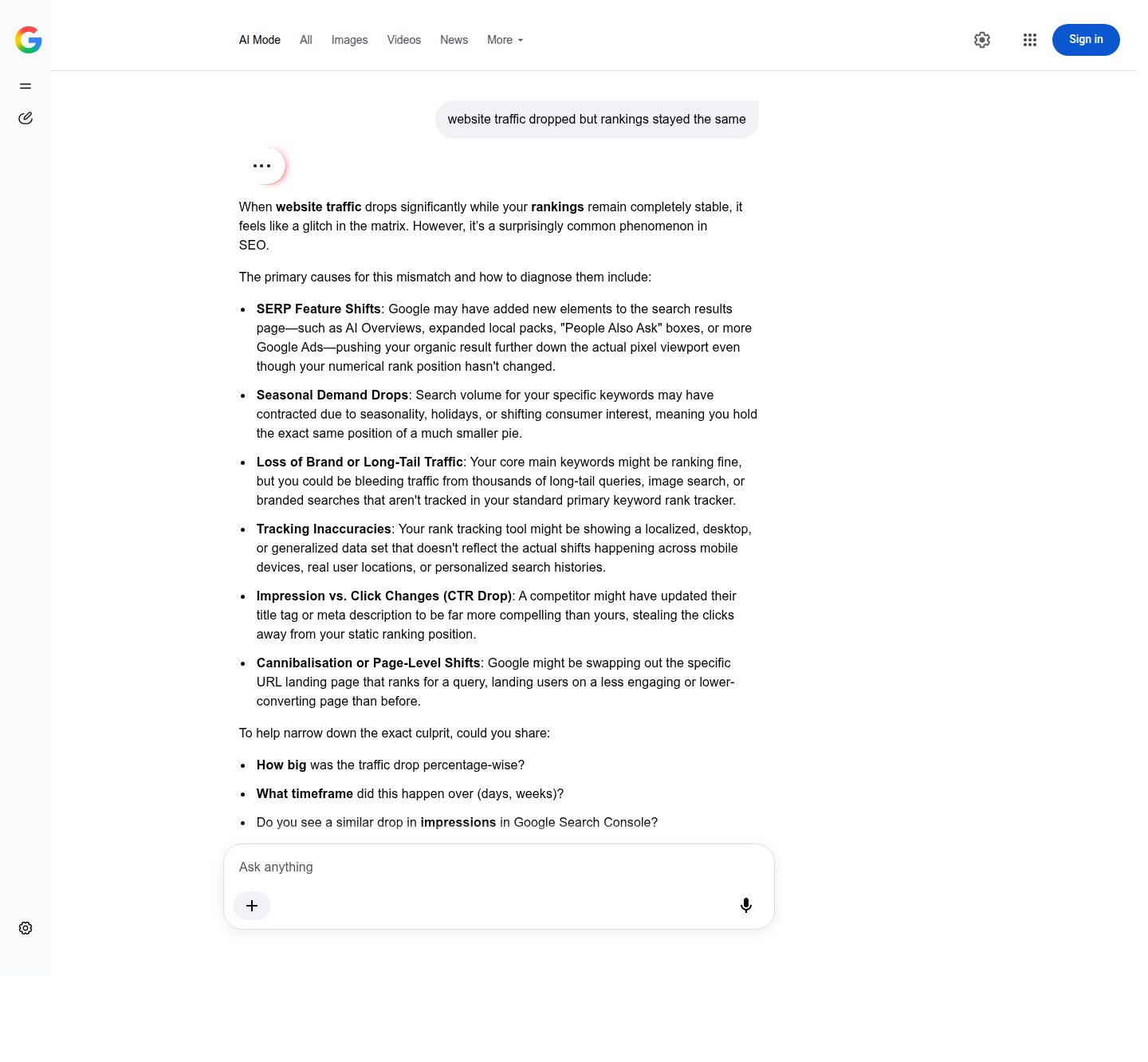
We ran four Google AI Mode searches. On 2 September 2026, we captured the matching organic results for those four neutral UK queries and sent two neutral prompts to web-enabled ChatGPT. The organic captures returned 32 entries across 25 domains. The two ChatGPT prompts returned the same causes, with no primary-source figure attached to any of them.
The gap this diagnostic takes from the test is the one a rank tracker cannot show you. One captured Google AI Mode answer named it 'Loss of Brand or Long-Tail Traffic': core tracked keywords can hold their positions whilst long-tail queries, image search and branded searches outside the tracked set lose clicks. A rank tracker averages the positions of the keywords it was given, so a steady average there says nothing about the queries it was never asked to watch. In Search Console, compare how many distinct queries earn clicks now against the same period last year, rather than reading a rank tracker's average position as the health of the whole site.
How to check which one is hitting you
Guessing which mechanic explains your specific drop wastes time. Two checks, one in each tool, settle it.
In Search Console: compare clicks against impressions by query over the last several months. A query where impressions have held steady, or even grown, while clicks fell is the strongest single signal that something above your listing is absorbing the click. Split the affected queries into branded and unbranded groups; if the drop concentrates in unbranded, informational terms, that matches the pattern AI Overviews create.
In GA4: check whether Direct traffic has grown at roughly the same time organic search traffic declined. A rising Direct trend that doesn't correspond to any obvious change in how people find your business by name is worth treating as miscounted AI referral traffic rather than genuine type-in visits. Then look at which landing pages lost sessions. Pages built to answer one specific informational question directly are the ones an AI Overview can summarise in full.
The pattern is easier to spot with a concrete case. A plumbing firm's page answering "how much does a new boiler cost" can hold its position and its impressions while its clicks fall away, because the figure a searcher wanted now sits in the AI Overview above the result. The same firm's page for its own company name shows no change at all. Two lines on the same Search Console chart heading in opposite directions is the pattern this diagnostic is looking for.
What this diagnostic doesn't cover
This page identifies the traffic-level pattern and how to confirm it. The full GA4 attribution method is covered at our guide to measuring AI search ROI. Zero-click search from first principles lives at our guide to the zero-click era. A drop in enquiries, calls or quote requests is a separate diagnostic, since traffic and enquiries can move independently. Ordinary causes are worth ruling out first as well: a seasonal dip, a site migration, a technical issue or a genuine change in demand can each produce a similar-looking graph. For the wider market picture, how ChatGPT and Google organic traffic compare and our state of AI search report are the background reads once the two checks above have narrowed things down.
Short version, restated
Start with the Search Console query check. Until you know whether impressions held while clicks fell, and on which queries, any GA4 work is guesswork about a pattern you haven't confirmed. Once that check identifies the affected queries, the Direct-traffic comparison in GA4 tells you how much of the loss has been counted in the wrong bucket.
Check whether AI platforms can find and cite your business
Those two checks tell you what happened to your traffic over the past year.
Check whether AI platforms can find and cite your business →
FAQs
Why did my website traffic drop this year?
Four related causes account for this pattern. Google's AI Overviews answer the question before a searcher reaches your result. AI-sourced visits land in your analytics as Direct rather than as search traffic. An unbranded informational query can be answered outright above your result; a search for your business name cannot. And zero-click search means the answer can be given on the results page itself. Rankings can hold steady while sessions fall, because all four of these act after the ranking is decided.
If my rankings haven't changed, why would my traffic still fall?
Ranking position measures where your result sits on the page. It doesn't measure whether anyone clicks it. When an AI Overview or a featured answer sits above your listing and already answers the question, a searcher can get what they need without visiting any site, including yours, even though your ranking position hasn't moved. That's a click-through problem, not a ranking problem, and Search Console shows it as impressions holding while clicks fall.
Why would AI-driven traffic show up as “Direct” in my analytics?
When someone clicks a link inside a chat answer from a tool like ChatGPT, those clicks can arrive without the referrer information a browser normally sends from a search results page. GA4 has nowhere else to file a visit with no referrer, so it defaults to Direct. That means flat or growing Direct traffic in your reports can be AI-referred traffic counted in the wrong bucket rather than new type-in visits.
Why do branded searches seem to hold up better than other traffic?
A searcher who types your business name is looking for you specifically, so an AI Overview cannot satisfy that intent, and may not appear at all. General informational questions are the ones an AI system can answer without sending anyone anywhere. When the drop concentrates in unbranded, top-of-funnel terms while branded terms hold steady, AI answers are the likely cause.
How do I check whether AI Overviews are actually the cause of my drop?
Two checks settle it. In Search Console, look for queries whose impressions held or rose while their clicks fell over the last few months, and separate branded terms from unbranded, informational ones. In GA4, see whether Direct traffic rose in the same period that organic search fell, then check which landing pages lost sessions: a page whose whole job is answering a single question has the least left to click through for.
Does this mean I should stop investing in my website?
No. Ranking well still matters, and it now has to be paired with being the source an AI answer cites and names. A site that answers a question clearly, quotably and with visible attribution still earns visits and citations. A site whose only asset is its ranking position is the most exposed to this shift.
Sources
No new external statistic is introduced here. The average organic click-through-rate decline associated with AI Overviews is published on how often Google answers with AI, so this page links it rather than restating it. The GA4 attribution method behind the Direct-traffic check is set out on our guide to measuring AI search ROI.
The figures above come from QBiz's own run on 2 September 2026: four Google AI Mode queries, the matching organic captures and two web-enabled ChatGPT prompts. The API responses and the SERP Screenshot reproduced above are the preserved record. The capture was made through an API, not from a Google browser session on our host.