Is AI the Reason My Enquiries Have Dropped?
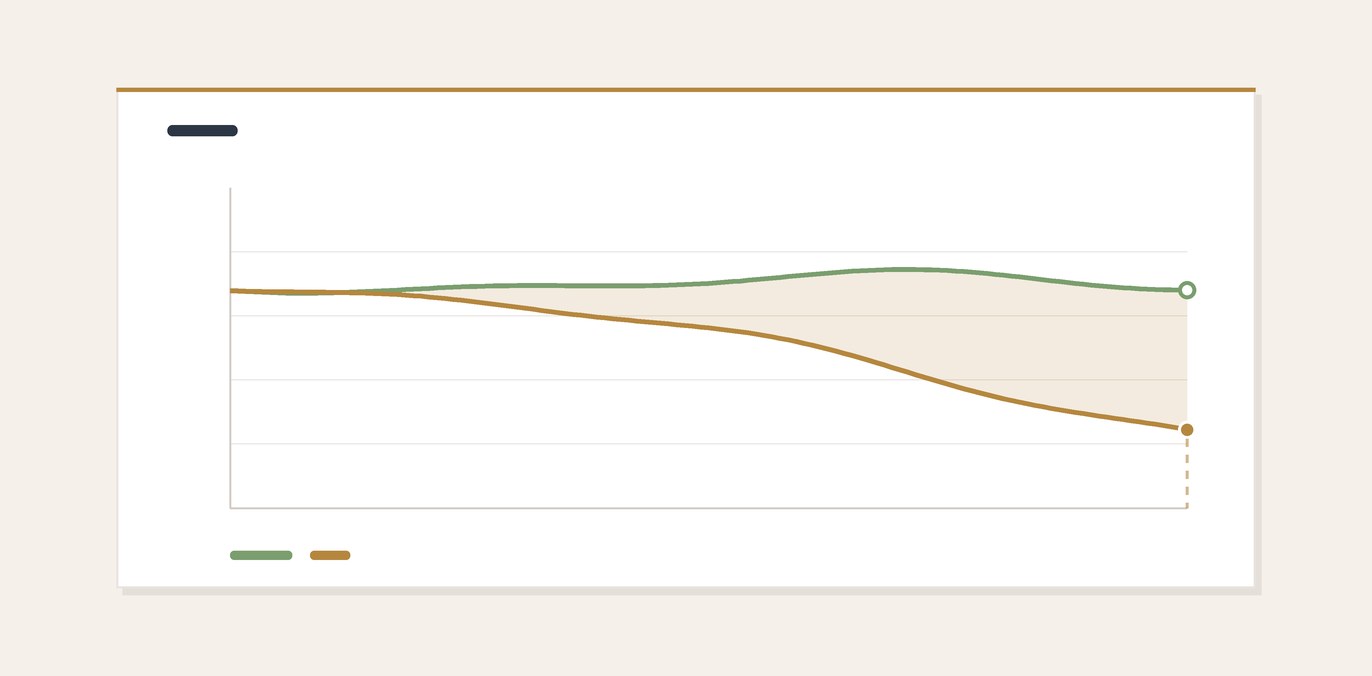
A falling enquiry count with steady traffic is a different problem to a falling traffic count, and it has a different likely cause. When AI answer engines resolve a factual question directly, a share of the people who would once have clicked through, read the page, and picked up the phone now get their answer without visiting at all. Before AI gets the blame, the ordinary causes need ruling out: seasonality, spend changes, a broken form, a pricing shift, a slower page. Once those are checked and the pattern still holds, concentrated on the pages that answer a single factual question well, the answer is to be the business the AI answer credits, and to make the page's next question one that still needs a real conversation.
Short version
- Enquiries and traffic can move independently; a steady visit count with a falling enquiry rate is the signature to look for.
- AI answer engines resolving a question directly means the click, and the enquiry behind it, can disappear even though nothing on the site changed.
- Rule out the ordinary causes first: seasonality, ad spend, pricing, a broken form, page speed.
- The pattern shows up hardest on pages that answer one clear factual question, such as pricing or "how it works" pages, and testing matched questions against several AI assistants confirmed the split: single-fact questions get answered in full more often than ones that depend on someone's own circumstances.
- The fix isn't winning the click back on a question AI can fully answer. It's being the source that answer credits, and making sure the next question still needs you.
Is AI the reason my enquiries have dropped?
It can be, and the way to tell is not by staring at your traffic chart. AI answer engines increasingly resolve straightforward, factual questions directly in the answer itself: what a service costs, how something works, whether a business covers a particular area. A person who would once have clicked through to your site to get that answer, then rung or filled in a form while they were there, now gets the answer without visiting at all. Nothing about your website changed. The conversation that used to end in an enquiry just never started, because it happened somewhere you can't see it.
The pattern lines up with what's been measured elsewhere. In a Pew Research Center study of US Google searches from March 2025, people who encountered an AI summary clicked a link inside that summary in just 1% of all visits to pages carrying one.[1] That's a US, Google-only figure from a single study, not a UK or cross-engine one, but it points at the same mechanism this article is about: the click a citation offers is rarely the click that gets taken.
This is a distinct problem from a traffic drop, and it needs a different diagnostic. Why Did My Website Traffic Drop This Year? covers the visit-count side of AI's effect on search. This article stays one layer down: even when visits hold up, the enquiries riding on top of them can fall, because the people still clicking through are arriving with fewer open questions left to ask.
Scroll to see the full figure
Enquiries and traffic move separately, and that's the tell
The pattern worth watching for is a falling enquiry rate against roughly stable session volume: fewer calls or form fills per hundred visitors, not necessarily fewer visitors in total. That's different from a straightforward traffic decline, and it points at a different mechanism. If your traffic has also fallen, Why Did My Website Traffic Drop This Year? is the right starting point, since AI Overviews reducing click-through and AI answers being logged as Direct rather than organic both live there.
It's also possible for both to be true at once, a genuine traffic dip plus a separate enquiry-rate dip, and conflating them leads to the wrong fix. A traffic problem is addressed by winning back visibility. An enquiry-rate problem, with traffic otherwise steady, is addressed by understanding what's happening to the visitors you're already getting, and by making sure you're still named in the answers that skip the click entirely.
Read the shape
Where has the drop actually landed?
Ask
Is the fall spread evenly across the site, or weighted onto the pages that settle one question?
Read it at the answer step
Longer pages and case studies holding their rate while the priced and coverage pages give way is the shape worth acting on.
Keep the search commercial
A uniform fall usually carries a plainer explanation, and a page-level fix will leave it exactly where it is.
Where this shows up first
Not every page is equally exposed. The pages most likely to show the pattern are the ones that answer a single, factual, well-defined question well, exactly the kind of question an AI answer engine is best equipped to resolve completely:
| Page type | Why it's exposed | What to check |
|---|---|---|
| Pricing / "how much does X cost" | A number is the whole answer; easy for AI to lift and state directly | Enquiry rate on this page specifically, not site-wide average |
| "How does X work" explainer | A short factual explanation is the entire ask | Whether the page still gets scroll depth and time-on-page, or just a bounce |
| Service-area / coverage pages | A yes/no or a list is the complete answer | Form starts vs form completions on this page |
| Comparison ("X vs Y") | The comparison itself is often the whole question | Whether visitors who land here go on to a contact page, or leave |
A drop concentrated on these page types, while a longer service page or a case study holds its enquiry rate, is a stronger signal than a uniform decline across the whole site.
A settled fact travels well; a complicated one still needs you
To see whether that split actually holds, we tested it directly. On 4 September 2026 we asked four AI assistants (ChatGPT, Claude, Gemini and Perplexity) and Google's AI Overviews the same twelve buyer questions across six everyday services: boiler replacement, dental implants, house rewiring, limited company tax returns, roof repair and conveyancing. Six questions were single-fact asks with one settled answer, such as how much a boiler replacement costs. The other six described a specific person's circumstances, the kind of question where the real answer depends on what's actually wrong: an ageing boiler with an awkward flue, a tooth needing an implant alongside some bone loss, a house rewired in parts and extended since. No business, brand or location beyond "UK" was named in any prompt, and every answer was read for one thing: could a reader act on it without visiting anywhere else.
The gap held up. Each set produced thirty responses. The single-fact questions were answered completely, with nothing left to check elsewhere, in 27 of their thirty (90%); the circumstance-dependent questions in 18 of their thirty (60%). The circumstance-dependent set was referred to a professional more than twice as often: 12 of its thirty responses (40%) against 5 of the single-fact thirty (17%). That is not an all-or-nothing result, and a page answering a nuanced question is not automatically safe from the same pattern. But the direction matches what shows up on the page types above. A single settled fact travels well inside an AI answer. A question that depends on someone's own circumstances is far more likely to still need a real conversation with a business.
What the test returned
Which questions an answer engine finishes
90%
of the single-fact asks came back complete, 27 of the thirty replies they drew
60%
of the circumstance-dependent asks did, 18 of their own thirty
17%
of single-fact replies sent the reader on to a professional, 5 of thirty
40%
of circumstance-dependent replies did, 12 of thirty, the wider referral gap
QBiz Leads AI test, 4 September 2026: twelve questions, six services, four assistants plus AI Overviews.
Rule out the ordinary causes before AI gets the blame
None of the diagnostic above counts for anything until the more common causes are checked and set aside:
- Seasonality. Some categories quiet down at certain times of year; compare against the same period last year, not last month.
- A change in paid spend. If ad budget was cut or a campaign paused, fewer enquiries may simply reflect fewer paid visitors, nothing to do with AI at all.
- A pricing or offer change. A higher price or a removed guarantee can suppress enquiries independent of how the traffic arrived.
- A broken or slower enquiry form. Check the form actually submits, loads quickly, and isn't buried behind a script error.
- A competitor's launch or a market shift. New entrants or a shift in what buyers are comparing can reduce your share of enquiries without AI being involved.
Only once these are checked and the pattern still points at fewer enquiries from a stable audience, concentrated on the answerable-question pages, is AI a reasonable working explanation.
How to check it properly
The full GA4 and Search Console configuration for isolating AI-referred and AI-influenced traffic is set out in How to Measure AI-Search ROI: A GA4 and Attribution Guide; this article assumes that segmentation exists rather than repeating the setup steps. Once it's in place, the check that matters here is enquiry rate within each segment, calls, form fills or quote requests per visitor, tracked over several months rather than a single week, since AI-driven click behaviour is more volatile week to week than ordinary organic traffic. Your Business Showed Up in ChatGPT Last Week and Not This Week explains why a single week's numbers can mislead either way. Tracking that over time is a separate discipline in itself, covered in How to Check If AI Recommends Your Business: Free Methods First.
The zero-click mechanism behind all of this, why an increasing share of search interactions never produce a click at all, is covered in full in Zero-Click Search Is Here: What It Really Means for a Small Business's Leads; this article doesn't re-teach that mechanism, only its effect on enquiries specifically.
Run it in this order
Working out what a quiet phone is telling you
Per hundred visitors
A divided figure, where a plain total holds steady and hides the whole movement underneath it.
By page type
A whole-site average blends the exposed pages with the safe ones and shows you neither clearly.
The plainer causes
Until every one is ticked off, an AI reading is a guess wearing a chart.
Across months
Week to week this behaviour swings hard enough to hand back whichever answer you went in expecting.
Can the enquiry come back?
Not by trying to win the click back on a question AI can now answer completely. If someone only wanted to know your opening hours or your starting price, and AI states that correctly, no amount of on-page optimisation recovers that specific click, because the reader's question is already answered before they'd ever reach your site.
That's not true of everyone, though. A 2026 vendor-published survey, run on a representative panel of 1,002 US adult consumers, reports that 23% of people are happy to rely on just the summary when making a decision, while 59% go on to check review profiles for more information.[2] The 59% are the enquiry that's still winnable: they've had the surface fact answered and are now looking for who to trust with it, which is exactly the moment being the cited business pays off.
What is recoverable is narrower and more useful: being the business the AI answer names and credits when it does answer, so the reader who needs more than the surface fact, who wants to book, compare, or ask a follow-up, lands on your site rather than a competitor's. How to Get Your Business Recommended by ChatGPT covers what earns that citation. The second lever is making sure the page's next logical question, after the factual one AI already answered, is something that genuinely needs a conversation: a quote specific to the reader's situation, a site visit, a decision only a human exchange can settle. A page that only restates the fact AI already gave away has nothing left to convert on.
On the exposed pages
Give the page what an answer cannot hand over
A quote that needs their details.Catches the reader at the point a stated starting price stops being enough for them.
The awkward version of the job.Catches the boiler with the difficult flue, the implant alongside bone loss, the house rewired in parts: the shapes a general reply walks past.
Facts stated so they can be lifted.Catches the reader inside the answer itself, at the moment it decides which business to credit.
The question that comes after.Catches the reader who arrived already satisfied on the surface fact and is now choosing who to trust with it.
A closing line that moves them on.Catches the visit on its way out, which is where a page that has only restated the answer loses it.
FAQ
Is AI the reason my enquiries have dropped?
It can be, particularly if your traffic and rankings look steady but calls, quote requests and form fills have fallen. AI answer engines increasingly resolve a question directly in the answer itself, so a person who would once have clicked through and enquired now gets what they needed without visiting your site at all. That's a different problem to a ranking drop, and it needs a different check.
How is this different from a traffic drop?
Traffic and enquiries can move independently. A business can hold its visit numbers steady while its enquiry rate falls, because the visitors still arriving are further down the decision than before, having already had their early questions answered by AI before they ever clicked. Conversely, traffic can fall for reasons that have nothing to do with enquiries, such as seasonal demand. This article stays at the enquiry layer: is the conversation happening somewhere you can't see it.
What does an AI-caused enquiry drop actually look like in the numbers?
Enquiry rate falls while sessions hold roughly level, so the drop shows up in calls and form fills per hundred visitors rather than in the visitor count. Pricing pages, how-it-works explainers and coverage pages are the ones to open first, because a single factual question is the kind an answer engine can settle outright.
Could something else be causing the drop?
Yes, and it has to be ruled out before AI gets the blame. Seasonality, a change in ad spend, a pricing change, a competitor's launch, a broken enquiry form, or a slower website can all cut enquiries without AI being involved at all. The diagnostic in this article only counts as evidence once those causes are checked and the pattern still points at pre-click answers.
Can I get the enquiry back if AI is already answering the question?
Not by winning the click back for that specific factual question; if AI can resolve it completely, some share of that traffic won't click through regardless of how well the page is written. What's recoverable is being the source the AI answer names and credits, so the reader who does need more than the surface answer still lands on your site rather than a competitor's, and structuring pages so the next question after the factual one still requires a real conversation with you.
Where do I check this properly?
Set up the GA4 and Search Console segmentation that separates AI-referred and AI-influenced traffic from ordinary organic traffic, then compare enquiry rate, not just visits, across that split over several months. The configuration steps for that segmentation live on a separate page; this one focuses on recognising the pattern and ruling out the other causes first.
Short version, restated
A quiet phone with an unchanged traffic chart points at the buyer's first question being settled somewhere you never see. That reading only stands once the ordinary commercial explanations have been checked and cleared. When it does stand, and the loss sits on the pages that answer one clear question, put the effort into being named in the answer itself, and into giving those pages a next step that only a conversation can settle.
See whether your enquiry-drop pattern lines up with AI answering questions before the click.
Check whether AI platforms can find and cite your business →
Sources
- [1] Pew Research Center, "Do people click on links in Google AI summaries?", 22 July 2025. Panel of 900 US adults, 68,879 Google searches, March 2025. Source URL: https://www.pewresearch.org/short-reads/2025/07/22/google-users-are-less-likely-to-click-on-links-when-an-ai-summary-appears-in-the-results/
- [2] BrightLocal, "Nearly Half of Consumers are Asking AI for Business Recommendations" (Local Consumer Review Survey 2026 AI mini-report). Representative panel of 1,002 US adult consumers, surveyed via SurveyMonkey. The two figures quoted here are stated by the report for people generally; the report's separate AI-user cut covers the 455 respondents who had used an AI tool for local business recommendations in the last 12 months. Source URL: https://www.brightlocal.com/research/lcrs-ai-trust/
Leave a comment
Thoughts on this post? Leave a comment below. Comments are moderated before they appear, so yours will not show on the page straight away.
Your email is used only to contact you about your comment if needed — it is never published.
Comments
No comments yet. Be the first to leave one above.